Materiality of Topic
Public concern over climate crisis has been rising in recent years. As government has declared its commitment to carbon neutrality by 2050, the responsibility of corporations has grown. In particular, social expectations for the financial sector are increasing, given its ability to influence corporate behavior through investment activities. Financial authorities are introducing various policies to support the green transition, while the international community is calling on companies to assess and disclose their impacts on climate change and natural capital. Accordingly, companies must recognize the importance of climate-related issues and continue making efforts to cope with the climate change.
Hanwha Life's Management Approach
Since declaring its coal phase-out finance policy in 2021, Hanwha Life has ceased investment and support for carbon-intensive projects, including the construction of coal-fired power plants in Korea and overseas. In addition, we are establishing environmental management systems (ISO 14001) and energy management Systems (ISO 50001) in line with internationally recognized standards. To raise environmental awareness among employees, we conduct various training programs and campaigns to embed culture of environmental management throughout the organization. We also participate in a range of global initiatives related to climate action and transparently disclose key indicators to stakeholders, including eco-friendly investments, greenhouse gas emissions, and impacts on climate and natural capital.
Hanwhalife
Sustainability
Hanwha Life is committed to sustainable management and
shared growth with all stakeholders.
Sustainability
Overview
Hanwha Life, Your trusted partner adding value to your life.
Hanwha Life, established in 1946, is the very first life insurance company in the Republic of Korea and it has led the development of the insurance industry and protected the health and happiness of Korean citizens. Based on our strong customer-centered management philosophy and our own unique product competitiveness, we are expanding the value of insurance to enrich the lives of customers and further fulfill our corporate social responsibility as we grow alongside our stakeholders.
ESG Strategy
We have established our ESG goal and are working to implement and manage our ESG strategy. Our ESG goal, “Green Life 2030 for sustainable tomorrow”, includes three strategic directions: “Internalization of environmental protection and eco-friendly management”, “Practicing social responsibility and sharing”, and “Establishing sound and transparent governance”. Under these directions, We seek to advance our ESG management and create shared value by implementing our ESG tasks.
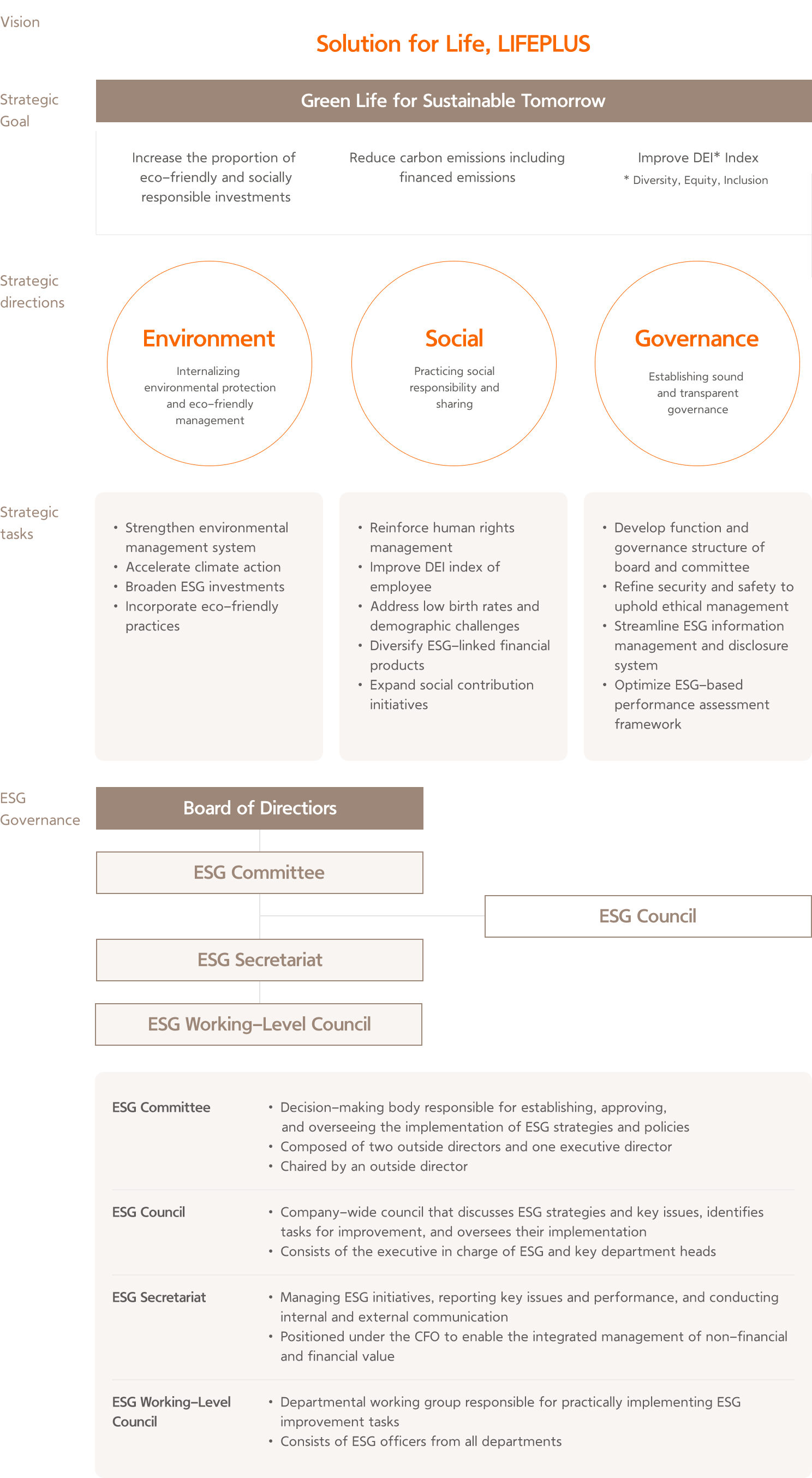
Environment
Internalizing Environmental Protection and Eco-friendly Management
As the importance of coping with climate change continues to grow due to abnormal climate, extreme weather, and ecosystem destruction caused by global warming, the social responsibility of financial institutions to support climate action through green finance and transition finance has come to the forefront. In response, Hanwha Life is strengthening its environmentally responsible management practices to reduce greenhouse gas emissions and establishing and ESG investment framework to accelerate green transition. In line with the recommendations of the Task Force on Climate-related Financial Disclosures(TCFD), we disclose climate-related information and are also making diverse efforts to minimize negative impacts on natural capital.
Social
Practicing Social Responsibility and Sharing
Companies grow symbiotically through interactions with a wide diversity of stakeholders in society. Accordingly, stakeholders are expecting companies to look beyond creating economic value, and take an active role in addressing social issues. Leveraging the nature of the insurance industry, which is closely engaged to people's lives, we fulfill our corporate social responsibilities by supporting vulnerable groups and youths preparing for independence. Through these efforts, we are creating social value and building a foundation of co-prosperity for both company and society.
Materiality of Topic
Businesses are being called on to take more assertive action to fulfill their corporate social responsibility. They are expected to actively engage with the communities in which they operate and strive to resolve social issues. Hanwha Life in particular, as a major insurer, is directly and indirectly connected to the everyday lives of all stakeholders, from customers to local communities, employees, and business partners. Therefore, we should do our own business in a way that prioritizes their needs.
Hanwha Life's Management Approach
Hanwha Life pays earnest attention to the voices of all stakeholders, from local communities to customers, employees, and business partners, and makes a variety of efforts to ensure their well-being. We are promoting inclusive financial products and services to expand insurance access for socially vulnerable groups; ESG products that address health and social problems, and ESG investment, innovation and finance for co-prosperity. We have also established an advanced consumer protection to enhance customer satisfaction along with many other efforts to fulfill our corporate social responsibility by sharing with local communities.
Governance
Building Sound and Transparent Governance
To maintain and grow the company in a rapidly changing business environment, we recognize the need to establish a sound governance structure and management system. With the growing importance of ESG management, it is also critical to control non-financial risks. To this end, we formed a balanced Board of Directors and a number of committees under the Board, including the ESG Committee, to move business forward and make decisions in the interests of our stakeholders, particularly shareholders and customers. In addition, by establishing a robust management system, we have sought to identify and manage both financial and non-financial risks in a proactive manner.
Materiality of Topic
The Board of Directors, as our highest decision-making body, deals with matters concerning business strategy and the company’s long-term growth.
The sound make-up and transparent operation of the Board is fundamental to ensuring long-term business continuity. Furthermore, because the ethical standards of the company determine its reputation, particularly in the financial sector, it is critical that we maintain customer trust by putting in place reliable systems to manage risks and protect customer data.Hanwha Life's Management Approach
We seek balanced decision-making by maintaining independence and diversity on the Board. In 2021, we created our ESG Committee to lay the foundations for ESG management, and in 2022, we have updated and adopted our “Corporate Governance Charter.” We have drafted and distributed ethical management policies and are striving to create an enterprise-wide culture of ethics and compliance. Furthermore, equipped with a risk management system for both financial and non-financial risks, we are pre-empting the uncertainties and potential losses that could occur as we do business in a rapidly changing financial environment.
ESG Evaluation
Excellence of Hanwha Life's ESG performances is recognized by ESG evaluation agencies.
ESG Ratings
| 2023 | 2024 | 2025 | |
|---|---|---|---|
 | Overall A (Environment: A / Social: A+ / Governance: B+) | Overall A (Environment: A / Social: A+ / Governance: B+) | Overall A (Environment: A+ / Social: A / Governance: B+) |
 | - | 39 | 55 |
 | - | Management (Climate Change) | Management (Climate Change) |
Global Initiatives
As a responsible corporate citizen, Hanwha Life is committed to creating a sustainable society. To this end, we have supported a number of global initiatives, with a view to identifying ESG issues and implementing ESG management.
- Category
- Contents
UNEP FI
(United Nations Environmental Programme Finance Initiative)- Aims to undertake a wide range of programs in partnership with the UNEP and financial institutions, in recognition of the critical role of financial institutions in sustainable development
UNEP FI PSI
(UNEP FI Principles for Sustainable Insurance)- The Principles for Sustainable Insurance declared by the UNEP FI, with a view to identifying, assessing, managing and monitoring the risks and opportunities related to environment, society and governance across the insurance value chain, including interactions with stakeholders

TCFD
(Task Force on Climate-related Financial Disclosure)- A committee established in 2015 by the FSB (FSB, Financial Stability Forum) upon the request from G20, to encourage companies to disclose information related to climate change, including climate- related governance, business strategy, risk management, climate change management targets & indicators, so that companies can effectively incorporate climate-related risks and opportunities into company-wide risk management and decision-making. (Integrated into the ISSB in 2023 and no longer operating as a separate initiative)

UNGC
(UN Global Compact)- The UNGC is the world’s largest voluntary corporate citizen initiative, espousing ten principles in the four areas of human rights, labor, the environment and anti-corruption to be incorporated into business operations and management strategies, in order to pursue sustainable management, enhance corporate citizenship as well as propose practical actions.

UN SDGs
(Sustainable Development Goals)- The UN SDGs were adopted by the 70th UN General Assembly in 2015 under the slogan ‘Leave no-one behind’. This initiative set the direction for the global community in the five areas of Humankind, the Earth, Prosperity, Peace and Partnership, consisting of 17 goals and 169 sub-goals to be achieved by 2030.

CDP
(Carbon Disclosure Project)- The CDP is a global climate change project that urges companies to disclose environmental information such as greenhouse gas emissions, crises and opportunities due to climate change, and carbon management strategies.

PCAF
(Partnership for Carbon Accounting Financials)- PCAF is a global partnership of financial institutions that work together to develop and implement an approach to assess and disclose the GHG emissions associated with their loans and investments. PCAF has developed an open-source global GHG accounting standard for financial institutions, the Global GHG Accounting and Reporting Standard for the Financial Industry.

TNFD
(Taskforce on Nature-related Financial Disclosures)- The Taskforce on Nature-related Financial Disclosures (TNFD) was formally announced in June 2021 to respond to the acceleration of global nature loss and decline. Based the success of the Task Force on Climate-related Financial Disclosures (TCFD), the TNFD aims to put nature at the heart of business decisions to reduce risks to nature and finance.
WEPs
(Women's Empowerment Principles)- A joint initiative launched in 2010 by the United Nations Global Compact (UNGC) and UN Women, providing guidance and implementation measures for companies that voluntarily pursue gender equality and women's empowerment in the workplace, industry, and local communities based on seven principles
Sustainability Report
Hanwha Life is publishing Sustainability Report which is aimed at sharing our ESG performance and activities with our stakeholders in a transparent manner.
2026 Sustainability Report
ESG Policies
Hanwha Life's ESG policies support sustainable management.
- Subject
- Attachment
- Corporate Governance Charter
- Board Independence and Diversity Policy
- Financial Consumer Protection Policy
- Ethics Charter
- Policy on Supplier Ethics
- Compliance Program
- Anti-Money Laundering Policy
- Anti-Bribery and Anti-Corruption Policy
- Information Security and Privacy Protection Policy
- Human Rights Policy
- Non-Discrimination and Anti-Harassment Policy
- Whistleblower Protection Policy
- Environmental Management Policy
- Occupational Health and Safety (OHS) Management Policy
- Social Contribution
ESG Bond Framework
Hanwha Life Sustainability Bond Framework
- Hanwha Life will use the net proceeds of Sustainability Bond to Green and Social projects. Hanwha Life defines a Framework which is a structure with relevant in Use of Proceeds, Process for Project Evaluation and Selection, Management of Proceeds, and Reporting
- The Framework sets out guidelines for Hanwha Life’s Sustainability Bond issuance in accordance with the 4 components of the International Capital Market Association’s 2021 GBP, SBP and SBG
Framework 4 Components
- 1. Use of Proceeds
The net proceeds of Sustainability Bond will be used to Eligible Projects;
- - Green categories: renewable energy, energy efficiency, sustainable water and wastewater management, pollution prevention and control, green buildings, clean transportation
- - Social categories: access to essential services, affordable housing, socioeconomic advancement and empowerment, accessibility to affordable and quality basic infrastructure
- 2. Project Evaluation and Selection Process
- Hanwha Life's Investment Business Division will manage the net proceeds are allocated to the projects and assets that meet the eligibility criteria as defined above as Eligible Projects
- The Investment Business Division will follow the guideline for ESG-complying investment created by the Investment Committee
- 3. Management of Proceeds
- Hanwha Life's plans to earmark the amount equal to the net proceeds from each issuance and keep track of its allocation
- 4. Reporting
- Hanwha Life's will publish a report on its website annually, up to the point where proceeds will have been fully allocated
Hanwha Life's Sustainability Bond Framework meets the criteria established in the protocol and aligns with the Green Bond Principles 2021, the Social Bond Guidelines 2021 published by the International Capital Market Association. The framework has obtained Second Party Opinion Certification from an independent external institution
Hanwha Life's Sustainability Bond Annual Report
Hanwha Life's intends to publish on its website the Sustainability Bond Annual Report which contains investment information based on the Sustainability Framework until the redemption of the securities.